
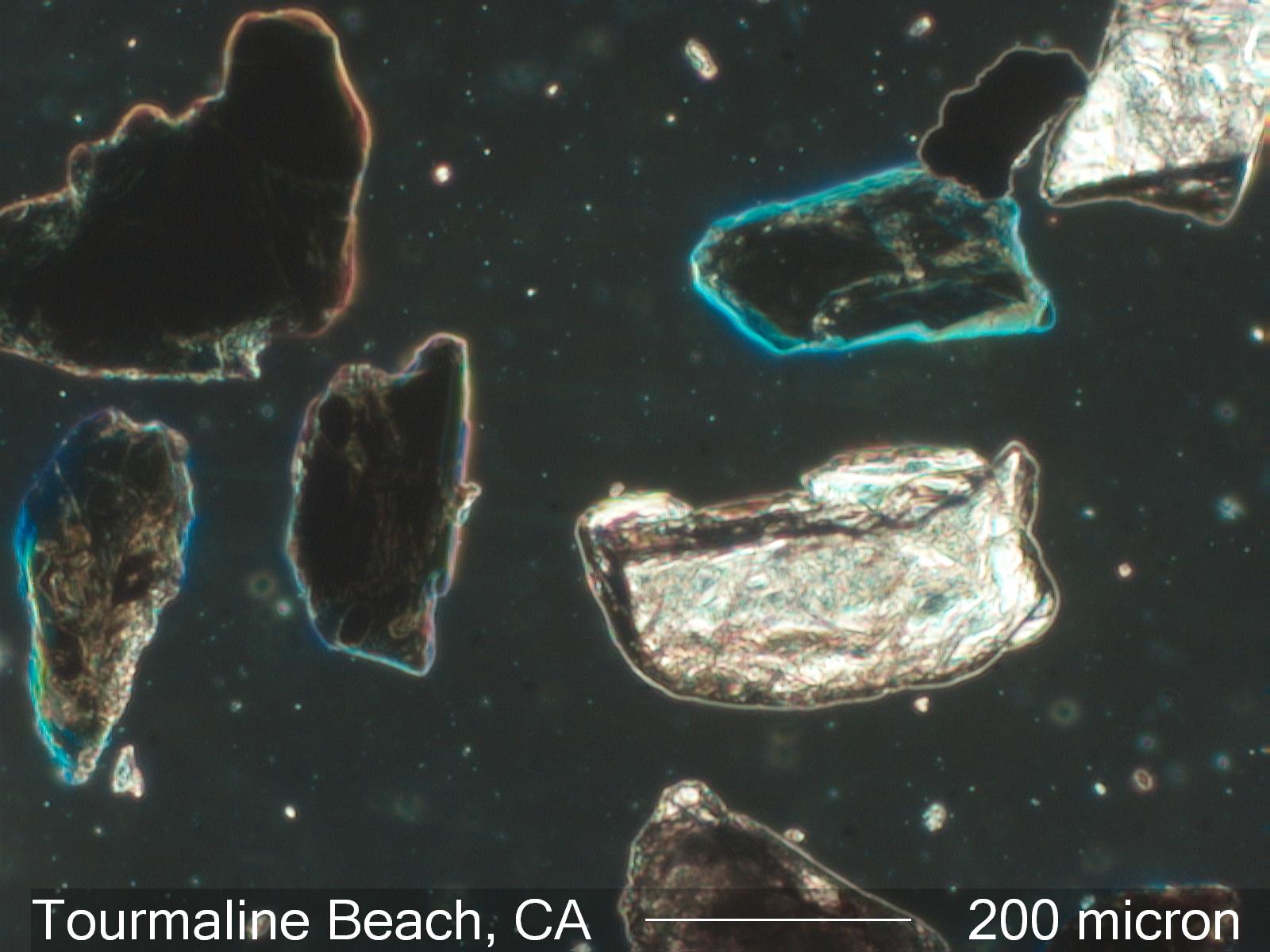
Sand, Tourmaline Beach, San Diego, CA
There are three tourmaline grains in this image. The two at the lower left are darker than the one in the upper center of the field of view because they are higher in iron content. With darkfield dispersion staining the light blue color of the upper center grain is the omega direction color and indicates an omega refractive index of about 1.65. The two grains on the lower left show a similar blue color but they are oriented so that the epsilon dispersion color is showing, 1.65 is near the epsilon refractive index.
Transmitted Linear Polarized Light, Darkfield Dispersion Staining Illumination Mounted
in 1.662 Refractive Index Medium
Definition/Function:
Tourmaline has the general formula of (Na,Ca)(Mg,Fe,Mn,Li,Al)3(Al,Mg,Fe)6[Si6O18](BO3)3(O,OH)3(OH,F). It is a common mineral in some granites or metamorphic deposits.
Sand is a large accumulation of small rock and/or mineral particles in the size range of from 20 micrometers to 2,000 micrometers in diameter. Sand may include small shells or shell fragments and oolitic deposits. Sand is a size and density segregated material that is the result of air or water action.
