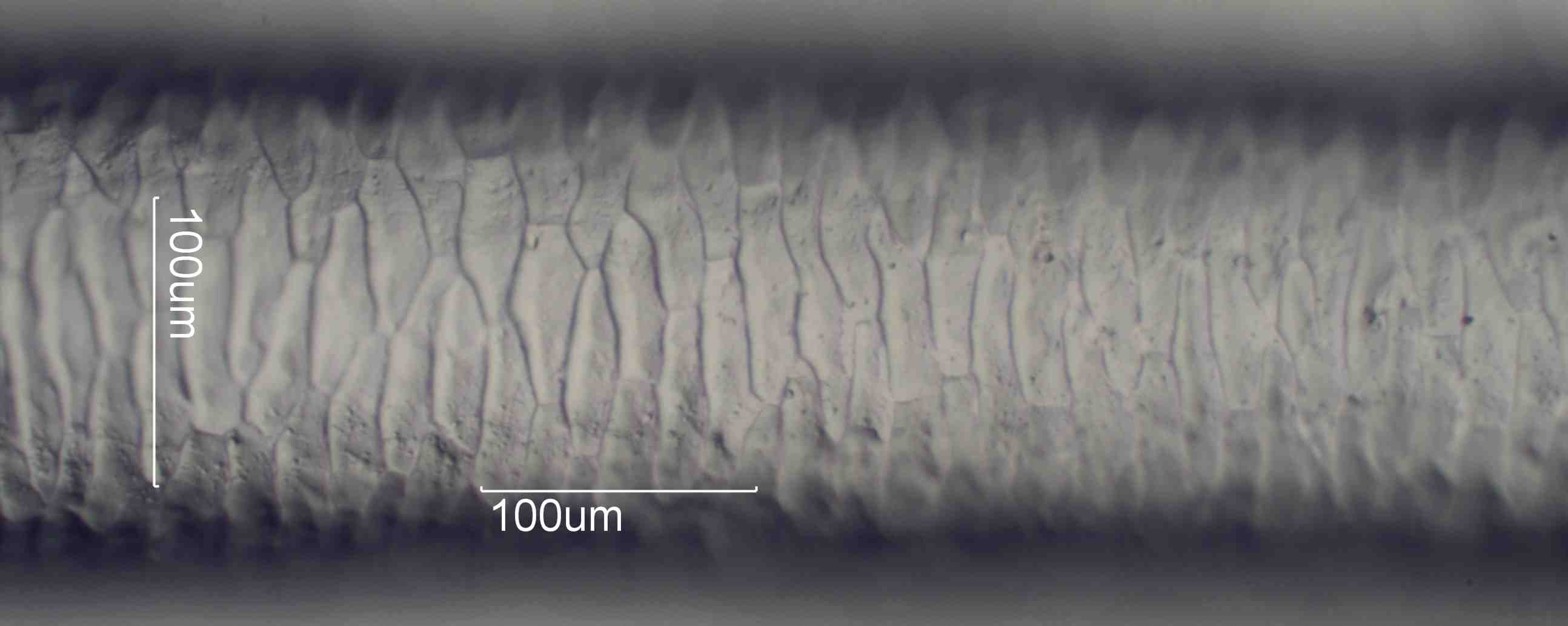
Caribou Hair
This is from the McCrone Hair Standards set.
Transmitted 20 Degrees Off Crossed Linear Polarized Light
Hausman, Leon Augustus, "Structural charactreistics of the hair of mammals", THE AMERICAN NATURALIST, vol. 54, no. 635, pp.496-523,
Hausman, Leon Augustus, "Recent studies of hair structure relationships", THE SCIENTIFIC MONTHLY, pp. 258-277,
Glaister, John, A STUDY OF HAIRS AND WOOLS, Misr Press, Cairo, 1931. FBI site for Animal Hair Identification: http://www.fbi.gov/hq/lab/fsc/backissu/july2004/research/2004_03_research02.htm
Keys Only
Mayer, William V., "The hair of California mammals with keys to the dorsal guard hairs of California mammals", THE AMERICAN MIDLAND NATURALIST, vol. 48, no. 2, pp. 480-512, 1952.
Stains, Howard J., "Field key to guard hair of middle western furbearers", JOURNAL OF WILDLIFE MANAGEMENT, vol. 22, no.1, pp. 95-97, January, 1958.
Mathiak, Harold A., "A key to hairs of the mammals of southern Michigan", JOURNAL OF WILDLIFE MANAGEMENT, vol. 2, no. 4, pp. 251-268, October, 1938.
Definition/Function:
This hair belongs to the group Rangifer tarandus. This group includes the North American Caribou and the Eurasian Reindeer.
Significance in the Environment:
Characteristic Features:
Caribou hair is about 100 to 150 micrometers wide from the root to near the tip. It has a lattice type medulla that nearly fills the hair. The cuticle pattern is imbricate flattened and has a scale count of about 7 per 100 micrometers. The scales are polyhedral, much wider than long. Caribou hair has a refractive index along its length of about 1.56 and perpendicular to its length of about 1.55. It has a birefringence of about 0.01 and a positive sign of elongation.Associated Particles:
References:
References with Photographs and/or DrawingsHausman, Leon Augustus, "Structural charactreistics of the hair of mammals", THE AMERICAN NATURALIST, vol. 54, no. 635, pp.496-523,
Hausman, Leon Augustus, "Recent studies of hair structure relationships", THE SCIENTIFIC MONTHLY, pp. 258-277,
Glaister, John, A STUDY OF HAIRS AND WOOLS, Misr Press, Cairo, 1931. FBI site for Animal Hair Identification: http://www.fbi.gov/hq/lab/fsc/backissu/july2004/research/2004_03_research02.htm
Keys Only
Mayer, William V., "The hair of California mammals with keys to the dorsal guard hairs of California mammals", THE AMERICAN MIDLAND NATURALIST, vol. 48, no. 2, pp. 480-512, 1952.
Stains, Howard J., "Field key to guard hair of middle western furbearers", JOURNAL OF WILDLIFE MANAGEMENT, vol. 22, no.1, pp. 95-97, January, 1958.
Mathiak, Harold A., "A key to hairs of the mammals of southern Michigan", JOURNAL OF WILDLIFE MANAGEMENT, vol. 2, no. 4, pp. 251-268, October, 1938.
