
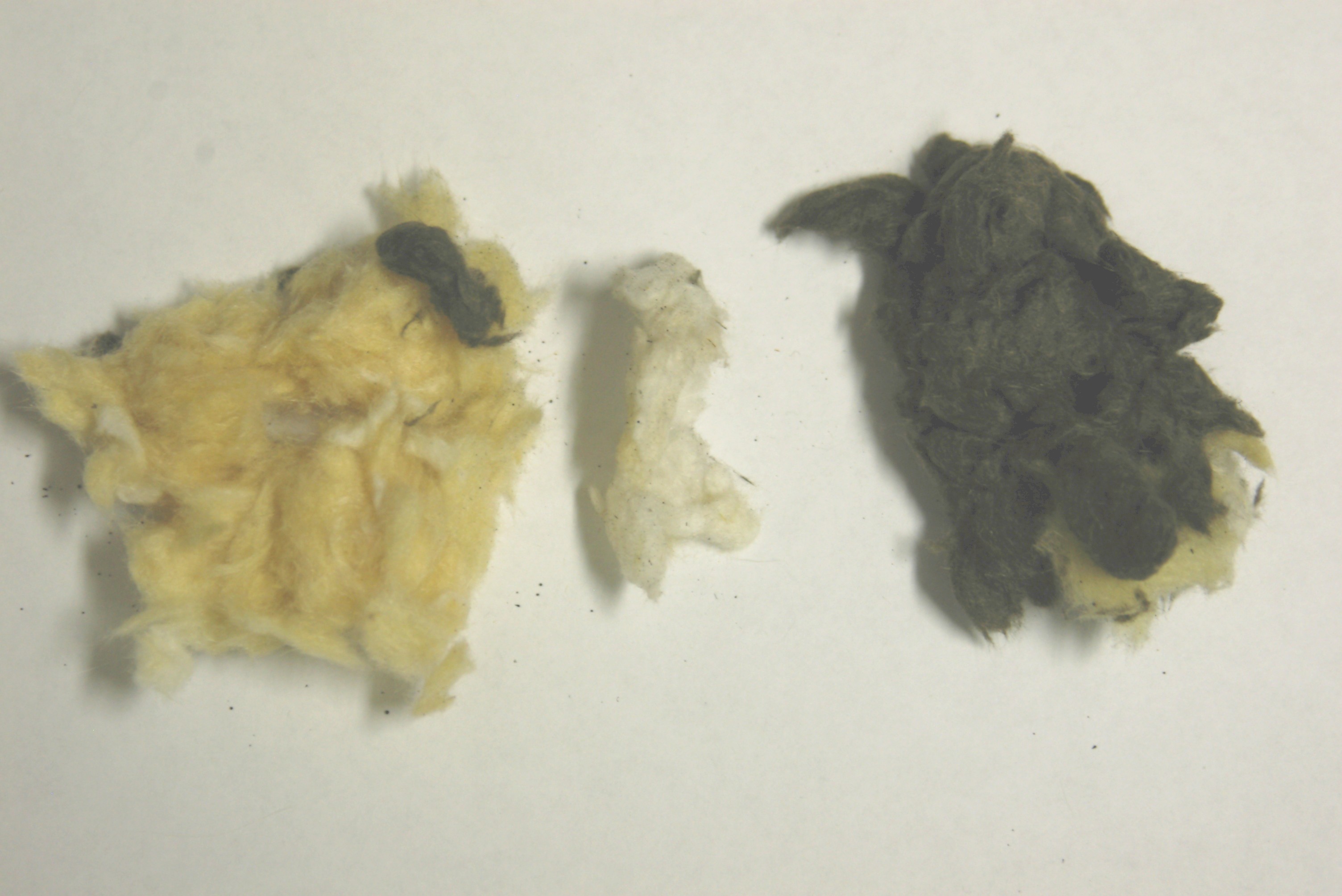
Glass Fiber, Bulk Insulation
Macro-Photograph
"Glass fiber", as identified by light microscopy, is defined by its morphology and a few optical properties. Its cylindrical shape (a result of surface tension at elevated temperature) is best seen by the relief gradient at the edge of the fiber when viewed with transmitted oblique illumination. The random molecular structure is demonstrated by the fact that the fiber is isotropic (disapears in all orientations when viewed between linear polarizing filters at 90 degrees to one another). The brittle nature of the fiber is shown by the lack of plastic deformation at the terminations of the fiber.
Definition/Function:
Glass fiber is a fiber composed of a material in a "glassy" state. A "glass" is any of a large class of materials that solidify from a molten state without crystallization and with random molecular orientation. They are regarded physically as supercooled liquids rather than true solids (based on the definition in the AMERICAN HERITAGE DICTIONARY). Chemically they generally contain silicon along with a number of other elements though carbon-based glasses are also common in some environments. It is estimated that there are in excess of 50,000 different chemical compositions for glass (MATERIALS HANDBOOK, by George S. Brady and Henry R. Clauser). Glass is easily formed at elevated temperature and can be made into fibers intentionally, as an artifact of thermal forming, or as a natural process as in the case of volcanic glass fiber (Pele's Hair)."Glass fiber", as identified by light microscopy, is defined by its morphology and a few optical properties. Its cylindrical shape (a result of surface tension at elevated temperature) is best seen by the relief gradient at the edge of the fiber when viewed with transmitted oblique illumination. The random molecular structure is demonstrated by the fact that the fiber is isotropic (disapears in all orientations when viewed between linear polarizing filters at 90 degrees to one another). The brittle nature of the fiber is shown by the lack of plastic deformation at the terminations of the fiber.
