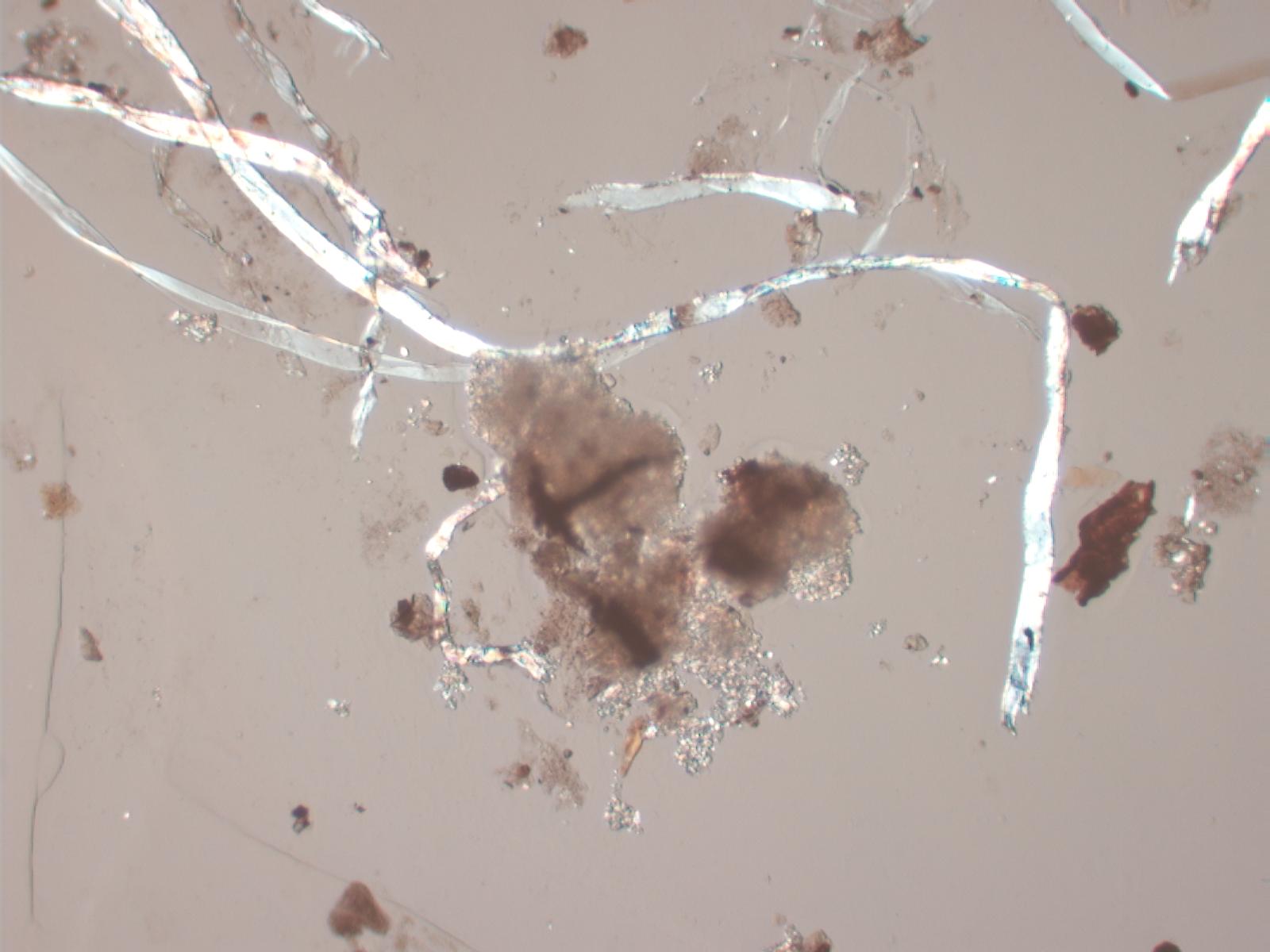
Cigarette Ash
This is a tapelift from the home of a person that smoked cigarettes indoors. The cigarette
ash is in the center of the image. On the right is a fragment of charred wood from the fireplace. The fibers in the
upper part of the field are a combination of paper fibers and degraded cotton clothing fiber.
Transmitted Off Crossed Polarized Light Illumination
Definition/Function:
Cigarette ash is the residue remaining after the burning of cigarette tobacco. Cigarette tobacco contains many more
inorganic additives than other tobacco products in order to promote even and continuous burning. One of the major
additives for this purpose is potassium nitrate. The result is the distinctive mix of highly birefringent inorganic
derivatives and charred leaf residues in the ash.
Significance in the Environment:
The presence of these particles in an indoor environment indicates the presence of a person who smokes cigarettes. It does
not necessarily indicate the smoking of cigarettes at this location. As the amount of cigarette ash increases it becomes
increasingly probable that a cigarette is being burned at this location.
Characteristic Features:
Cigarette ash is a bit unique among the plant ashes because of the potassium nitrate and other substances added to the
tobacco in a cigarette. The result is that the ash is associated with a significant amount of highly birefringent
small crystals. Often the amount of charred plant matter is quite small compared to the associated mass of small
highly birefringent crystals. The white ash is an agglomerated particle containing numerous individual particles ranging
from about two micrometers to sub-micrometer in diameter. The individual particles are rounded rather than having any
crystalline face evident. No background matrix material is evident but often there are traces of charred plant fragments
present.
Associated Particles:
If there are a number of cigarette ash particles present in a sample then it increases the probability that some of the
clusters of highly birefringent crystals seen in that environmental sample are from cigarette ash. Distinguishing between
cigarette white ash, some sodium nitrate aerosols, some carpet adhesive decomposition products, some plaster or spackle
dusts, etc. will require closer examination of the size distributions, shapes, and associated chemical phases in the
agglomerated particle.
References: