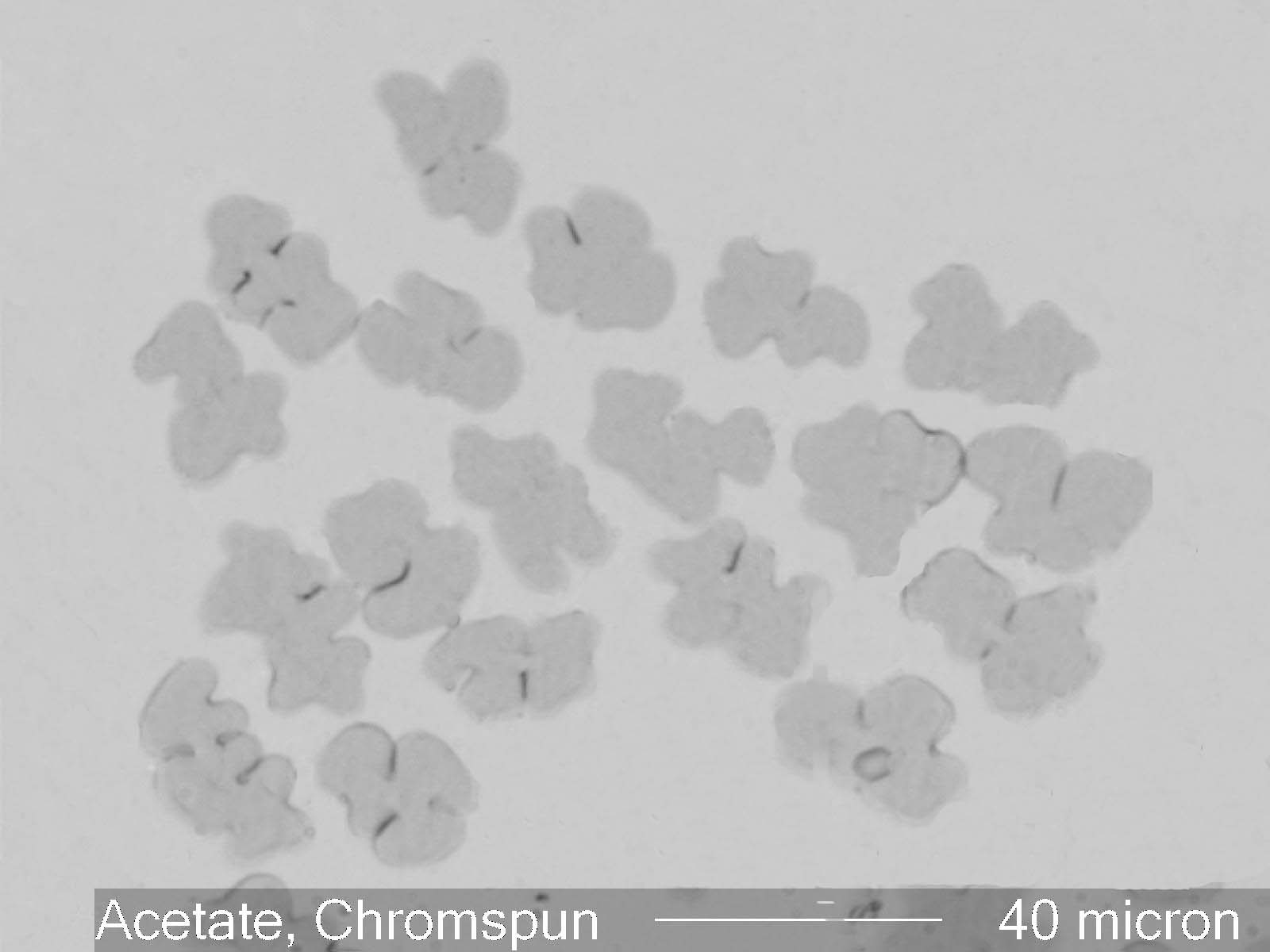
Blue Acetate Fiber, Chromspun, Cross-Section
This is a cross-section sample of Chromspun acetate Fiber
from the sample-set provided by Textile Fabric
Consultants, Inc.
Reflected Brightfield Illumination
Definition/Function:
Acetate fiber is a cellulose derivative. Wood cellulose or cellulose from cotton linters
is often used as the starting
material. It is formed by drawing the cellulose solution through a spinneret into an
acid bath where it solidifies from
the outside in. This results in the crenulated cross-section because the outside
polymerizes first and is drawn more rapidly
though the bath than the interior of the fiber that is still liquid. The draw-rate
affects the fiber diameter and the
degree of crenulation. Acetate fiber was commercially produced starting in about 1929.
Significance in the Environment:
This is a common clothing fiber.
Characteristic Features:
Acetate has a refractive index along its length of about 1.47 to 1.48 and perpendicular
to its length of about 1.47 to 1.48.
It has a birefringence of about 0.004 or lower and a negative sign of elongation. It
exhibits irregular striations along
its length due to the crenulated cross-section of the fiber.
Associated Particles:
References:
DuPont Company Techinical Bulletin X-156: IDENTIFICATION OF FIBERS IN TEXTILE MATERIALS,
December 1961.