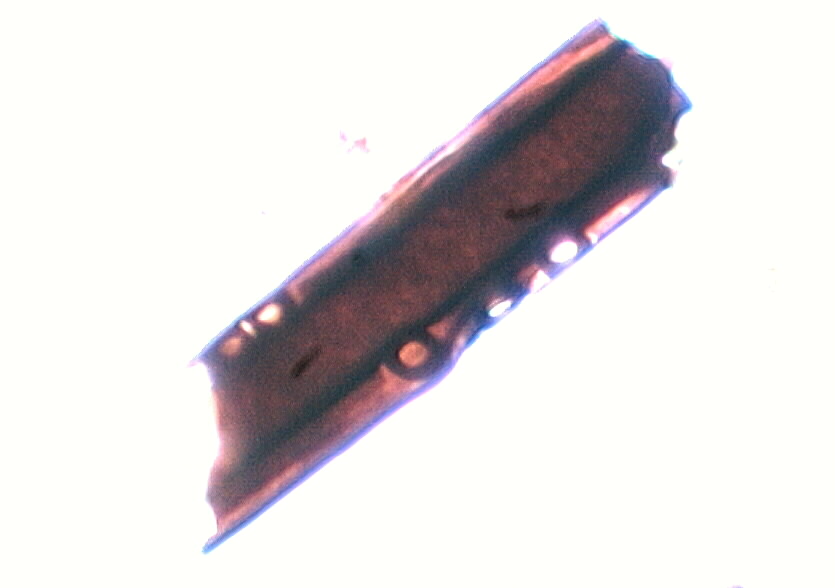
Charred Softwood
The large, well separated pores (circular patterns)
identify this fragment as coming from a
conifer or softwood tree.
Transmitted Brightfield Illumination
Definition/Function:
Significance in the Environment:
This type of particle is common where
softwoods are used as a fire wood and from forest fires, slash burns, hog fuel boilers,
or, more in
the past, TPee burners to dispose of waste from lumber mills. Charred wood is one of the
more common
airborne particles in urban and suburban environments. Indoors it can indicate
back-drafting of a fireplace.
Characteristic Features:
The large, well separated pores (circular patterns) identify this fragment as coming
from a
conifer or softwood tree. The pore structure in this sample is different than that seen
in the
other example provided in this section of the gallery. The pore stucture is important in
helping
to determine the species or at least eliminate possible species as a source. The brown
coloration
indicates the loss of hydrogen in the cellulose that makes up the cell structure of the
wood. That
is the result in this case of exposure to high temperatures.
Associated Particles:
References: