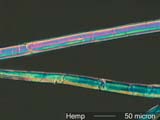
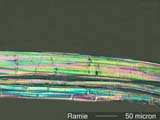
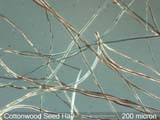
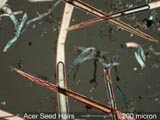
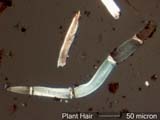
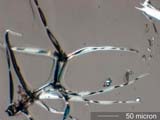
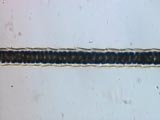
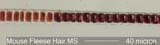
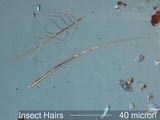
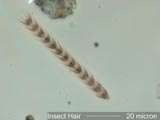
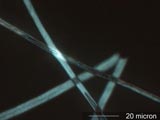
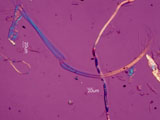
This is part of a guide to the identification of particles seen in samples of
free particles.
This file includes all particles that have approximately parallel sides and are
at least five times as long as they are wide.
ISOTROPIC FIBERS
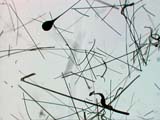
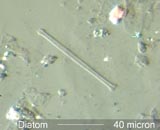
These are particles that are dark when viewed between crossed
polarizing filters. They tend to be glass (inorganic or organic),
fungal fragments,
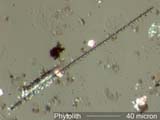
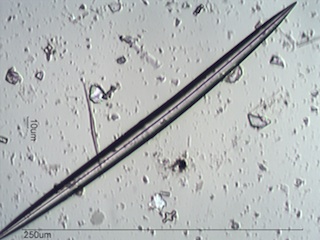
algae fragments, bacterial sheaths, or silica phytoliths.
ANISOTROPIC FIBERS
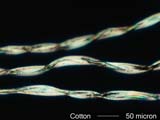
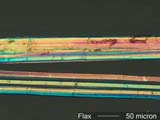
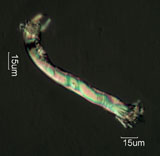
These are particles that are bright when viewed
between crossed polarizing filters.
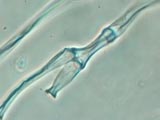
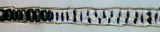
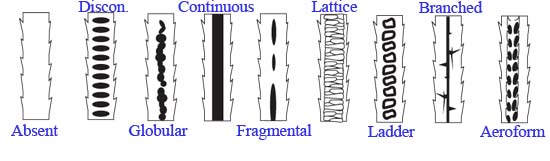
Fibers with Internal Cells
or internal Voids
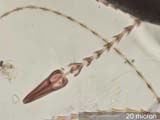
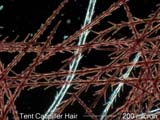
These particles tend to be plant
fibers, plant hairs, animal hairs,
insect hairs, or fungal structures.
These
structures
may also be
called nodes
and occur in
many plant
fibers but
may also
occur in
some
man-made
plastic
fibers.
Fibers
with
Tapered
Terminations
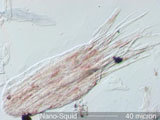
These
fibers
may
grow
tapered
ends,
like
hairs
of
plants
and
animals,
or
may
plastically
deform
and
taper
prior
to
final
break.
Paper
fibers
also
tend
to
have
tapered
ends.
Fibers
with
Broomed
Ends
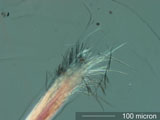
These
fibers
tend
to
be
fibers
that
consist
of
bundles
of
parallel
finer
fibers
referred
to
as
fibrils.
They
include
some
plant
fibers,
mammalian
hair,
some
natural
mineral
fibers,
and
some
soft
polymers
that
form
zones
of
stress-aligned
fibrils
when
under
load
(i.e.
polypropylene).
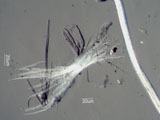
Fibers
that
Keep
Dividing
into
Finer
Fibers
Parallel
to
Length
These
fibers
tend
to
be
mineral
fibers,
including
those
identified
as
asbestos.